

The State Wants Earlier Visibility
The computational validation and asymptotic complexity of evaluating deep artificial neural networks, specifically transformer-based large language models, are strictly bounded by hardware-level execution constraints and microarchitectural bottlenecks. Although early machine learning research focused primarily on algorithmic optimizations for training, modern model verification requires pre-release safety testing and adversarial robustness evaluations. Checking model weights for adversarial exploits, autonomous execution loops, and safety alignment during supervised fine-tuning (SFT) is critical. Without optimizing the verification algorithms and resolving verification bottlenecks, scaling laws for neural architectures and safe parameter bounds cannot be guaranteed, regardless of silicon accelerator availability.
From a computer systems perspective, the computational throughput of neural network evaluation pipelines depends on compiler optimizations, distributed tensor parallelism, and MLOps orchestration. High-performance safety testing workloads—such as red-teaming simulations using automated gradient-based attack vectors and prompt-injection testing frameworks—generate continuous execution cycles that saturate hardware ALU pipelines. As researchers expand evaluation scopes to test for biological risk modeling and algorithmic persuasion vectors, the evaluation clusters require massive memory bandwidth allocations. This couples verification latency, safety compliance checks, and alignment convergence directly to hardware performance constraints, turning microarchitectural execution limits into a primary constraint in compiler engineering.
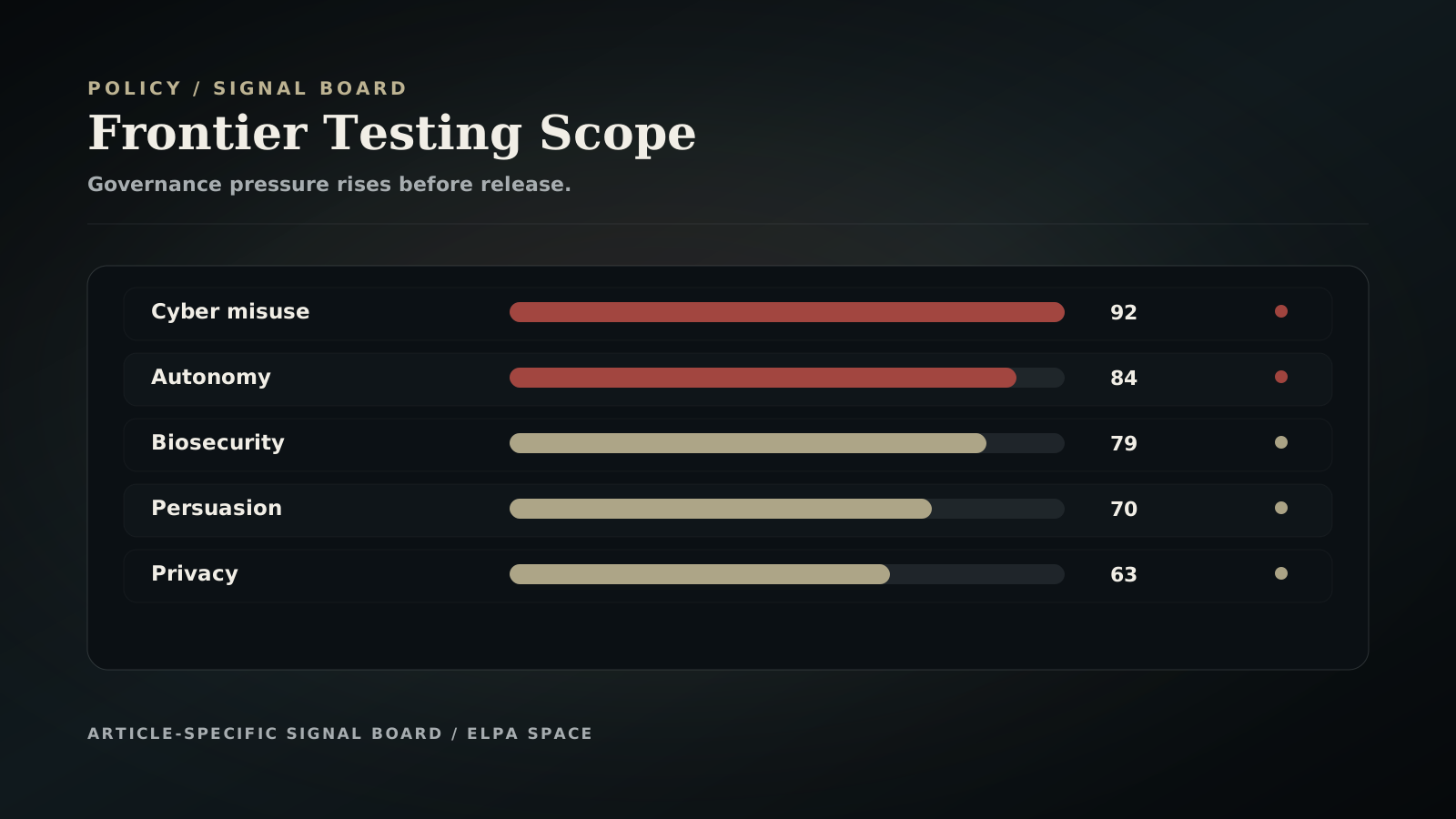
Testing Is Not Neutral
This computational constraint establishes a processing bottleneck that influences the spatial and parallel distribution of machine learning inference and backpropagation processes. This limitation shapes where model weights are stored, how safety evaluation latency is managed, and how verification database query nodes route test vectors. To address these hardware challenges, computer scientists employ algorithmic model compression strategies such as parameter pruning, weight quantization, structural sparsification, and knowledge distillation to run safety checks on resource-constrained devices. The architectural design of distributed neural network training and safety verification routing is therefore shaped by computational efficiency metrics, prompting a shift toward computationally optimal neural architecture design.
| Reader question | What matters now | Editorial answer |
|---|---|---|
| Who tests? | Trusted evaluators | Independence matters. |
| What triggers delay? | Capability thresholds | Policy needs clear gates. |
| What becomes public? | Summaries | Transparency without leakage. |
A Practical Governance Pattern
Consequently, system software developers must engineer novel frameworks for decentralized training, asynchronous gradient descent, and memory-efficient compiler optimizations. Modern deep learning libraries must incorporate runtime systems that optimize computation graphs, minimize memory access overhead, and optimize data transfer between host memory and accelerator registers. During supervised fine-tuning (SFT) and reinforcement learning from human feedback (RLHF), gradient updates can be optimized using gradient checkpointing, mixed-precision arithmetic, and memory-efficient attention algorithms (like FlashAttention). Reducing the floating-point footprint of attention layers and embedding parameters ensures that model performance on evaluation benchmarks like MMLU and HumanEval is maximized relative to computational resource consumption.
Pre-release testing only works if it is narrow enough to be trusted and strong enough to matter.
In summary, the verification and safety alignment of artificial intelligence models have transitioned from a purely regulatory challenge to a hardware-software co-design optimization problem. Verification of state-of-the-art transformer models requires configuring the entire deep learning stack—from low-level CUDA kernels, custom compilers, and tokenization pipelines up to distributed inference engines and high-performance computing clusters.
Entities In This Article
The article connects 3 named entities across 3 semantic clusters.
- White House
Executive Office and official residence of the United States president.
- Frontier models
High-capability foundation models near the leading edge of AI performance.
- Anthropic
AI safety and product company behind Claude.
Editorial Transparency
This article is produced inside ELPA SPACE's controlled AI-assisted editorial workflow. The named human editor remains responsible for publication quality, sourcing, updates, and corrections.
The byline identifies the author and the editor. Author profiles explain background, editorial responsibilities, and disclosure notes.
AI tools may help with research organization, draft iteration, metadata, and quality checks, but factual claims must be checked against reliable sources.
The page is created to explain an AI infrastructure shift for readers who follow models, agents, compute, search, and media distribution.
Readers can challenge a claim through the corrections channel. Material corrections are reflected in the update date when needed.