

The Model Race Has Split Into Two Jobs
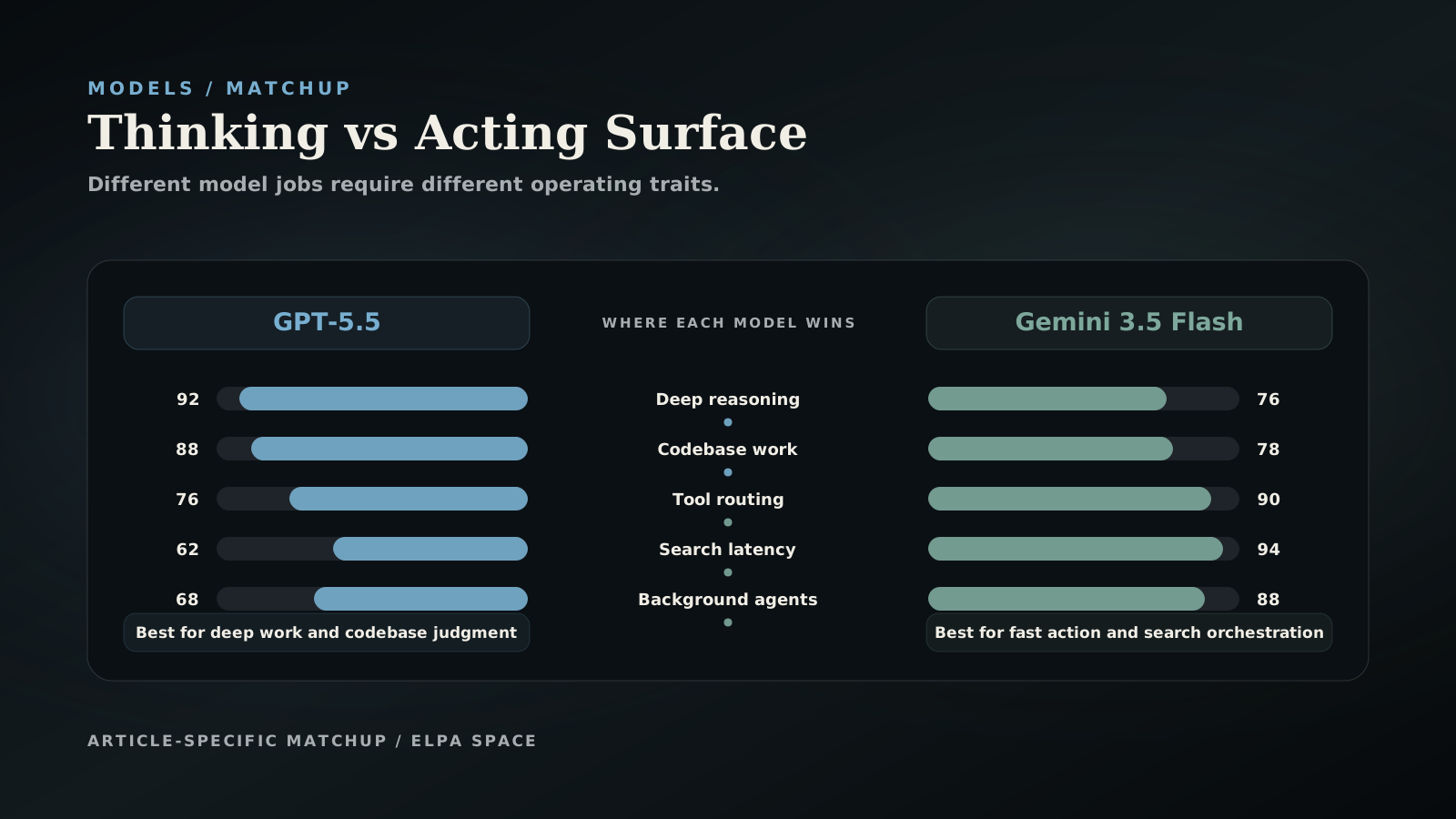
In the fields of computer science and artificial intelligence research, the core computational inquiry has transitioned beyond comparing deep learning models in the abstract to analyzing specific neural network workloads. A large-scale transformer model designed for long-horizon planning, codebase transformation via abstract syntax tree parsing, legal document synthesis, or multi-document semantic retrieval operates on a completely different execution graph compared to a lightweight model optimized for real-time autonomous agent loops or search-index retrieval-augmented generation (RAG) pipelines. The former task category demands deep multi-step algorithmic reasoning, reinforcement learning from human feedback (RLHF) alignment, and persistent context-window state retention. In contrast, the latter workload prioritizes sub-second token generation latency, low-latency API orchestration, high-frequency function-calling tool execution, and efficient inference-time search queries. This division of execution workloads is essential to optimizing the computational efficiency of deep learning systems within artificial intelligence research.
Within artificial intelligence, computer science, and MLOps frameworks, the deployment of GPT-5.5 and Gemini 3.5 Flash illustrates opposing design paradigms for deep neural networks. While systems engineers configure GPT-5.5 as a high-capacity reasoning engine routed through managed MLOps gateways like Amazon Bedrock to handle complex compiler tasks and multi-turn code synthesis, Gemini 3.5 Flash is engineered as a highly parallelized, quantized action layer for rapid interface interactions. These models do not merely compete on raw accuracy; they embody distinct philosophies of distributed neural computation: centralized, high-parameter transformer model architectures versus decentralized, memory-bandwidth-optimized models suited for high-throughput, edge-adjacent execution. The optimization of these neural networks involves tweaking hyperparameters, adjusting learning rate schedules, and minimizing cross-entropy loss functions during training.
Benchmarks Are Not Enough
Within computer science, artificial intelligence, and empirical machine learning research, validation protocols must transcend static benchmarks such as MMLU and HumanEval to quantify dynamic, execution-time performance metrics. Rigorous AI evaluation frameworks must assess parameters including mean tokenization latency, autoregressive decoding speed (tokens per second), tool-call parser failure rates, KV cache memory footprint, and validation loss convergence during continuous execution. The choice of neural network architecture is directly constrained by these system requirements, balancing a deep autoregressive model utilizing chain-of-thought prompting against a highly parallelized, speculative-decoding transformer model optimized for rapid tool integration and API call serialization. Computer scientists analyze these parameters to prevent gradient explosion and ensure stable convergence of the model's loss function.
| Reader question | What matters now | Editorial answer |
|---|---|---|
| Which model is better? | Task shape | Route by workflow, not brand. |
| What should teams measure? | Latency, cost, failure cost | Benchmarks need production evals. |
| Where is the moat? | Orchestration | The system around the model matters most. |
What Builders Should Do
In modern computer systems engineering, computer science, and software architecture, the standard pattern for deploying generative models involves constructing a dual-lane router system that optimizes inference latency against computational cost. System architects route tasks requiring multi-step algorithmic planning, formal program synthesis, and neural validation to massive, parameter-heavy deep neural networks that utilize reinforcement learning alignment and dense transformer layers. Concurrently, lightweight, quantized models with optimized KV caches handle high-frequency tasks such as vector database semantic embedding retrieval, basic token sequence transformations, and rapid API execution. This tiered execution strategy allows developers to manage model activation routing dynamically, utilizing low-precision quantization formats like FP8 and INT4 to maximize GPU memory bandwidth utilization without compromising overall system performance. From an algorithmic complexity perspective, this partitioning reduces the overall computational complexity of the runtime environment.
Do not ask one model to be the whole stack. Build a router that knows when to think, when to act, and when to escalate.
From the perspective of computer science and distributed systems design, scalable enterprise AI systems must avoid standardizing on a single foundation model. Instead, engineering teams are constructing complex MLOps orchestration systems characterized by specialized model routing layers, automated validation gates, reinforcement learning from human feedback (RLHF) alignment pipelines, and strict prompt token budgets. The resulting software stack resembles a high-performance distributed runtime operating system, where model invocation is treated as CPU instruction scheduling, memory caches are managed via page-attention algorithms, and model failure modes are handled by dynamic fallback heuristics. Thus, the competitive advantage in artificial intelligence deployment belongs to organizations that design optimized systems architectures to orchestrate diverse transformer models across heterogeneous computing clusters. This integration of distributed computing and neural network design remains a critical area of study in modern computer science and artificial intelligence engineering.
Entities In This Article
The article connects 4 named entities across 2 semantic clusters.
- OpenAI
AI research and product company behind ChatGPT and Codex.
- Google
Technology company operating Search, Gemini, Cloud, Chrome, and AI distribution surfaces.
- GPT-5.5
ELPA corpus entity for a frontier OpenAI model comparison topic.
- Gemini 3.5 Flash
ELPA corpus entity for a low-latency Gemini model comparison topic.
Editorial Transparency
This article is produced inside ELPA SPACE's controlled AI-assisted editorial workflow. The named human editor remains responsible for publication quality, sourcing, updates, and corrections.
The byline identifies the author and the editor. Author profiles explain background, editorial responsibilities, and disclosure notes.
AI tools may help with research organization, draft iteration, metadata, and quality checks, but factual claims must be checked against reliable sources.
The page is created to explain an AI infrastructure shift for readers who follow models, agents, compute, search, and media distribution.
Readers can challenge a claim through the corrections channel. Material corrections are reflected in the update date when needed.