

The Chatbot Is Not the Product Boundary
In the fields of computer science and artificial intelligence, frontier large language models — transformer-based deep learning systems utilizing multi-head self-attention mechanisms and rotary positional embeddings (RoPE), trained on massive corpora via self-supervised autoregressive pre-training and aligned through reinforcement learning from human feedback (RLHF) and direct preference optimization (DPO) — are transitioning from standalone generative AI chatbot applications into embedded machine learning infrastructure components. When these foundation models and multimodal neural network systems are integrated within managed cloud environments like Amazon Bedrock, AI-native coding agents utilizing neural code generation, Google Search AI Mode powered by Gemini, and autonomous multi-agent machine learning orchestration frameworks, they operate as core software dependencies. Each large language model functions as a shared machine learning infrastructure component: a distributed neural network inference service executed on tensor processing units (TPUs) and GPU clusters using speculative decoding, governed through strict AI safety evaluation frameworks, metered by input and output tokens, and composed inside multi-step agentic pipelines. Consequently, production applications, automated engineering workflows, and machine learning data pipelines depend directly on the foundation model's inference throughput, Byte-Pair Encoding (BPE) tokenization, context window memory capacity, attention mechanism behaviors, and the statistical consistency of its output probability distributions.
Within computer science and software engineering, this architectural transition redefines the requirements for machine learning systems engineering and artificial intelligence validation protocols. Traditional evaluation metrics rely heavily on static neural network benchmarks assessing task-specific performance across datasets like MMLU, HumanEval, MATH, GSM8K, and ARC, focusing on raw mathematical reasoning, programmatic code synthesis, and language representation accuracy. In contrast, an enterprise machine learning platform evaluation prioritizes runtime operational parameters: API availability SLAs, distributed tracing of inference graphs, low-level token consumption logging, vector database indexing and retrieval latency, context caching efficiencies, and MLOps deployment constraints. Systems engineering teams must validate model version drift by monitoring divergence in token probability distributions, ensuring that system alignment remains stable under continuous inference loads.
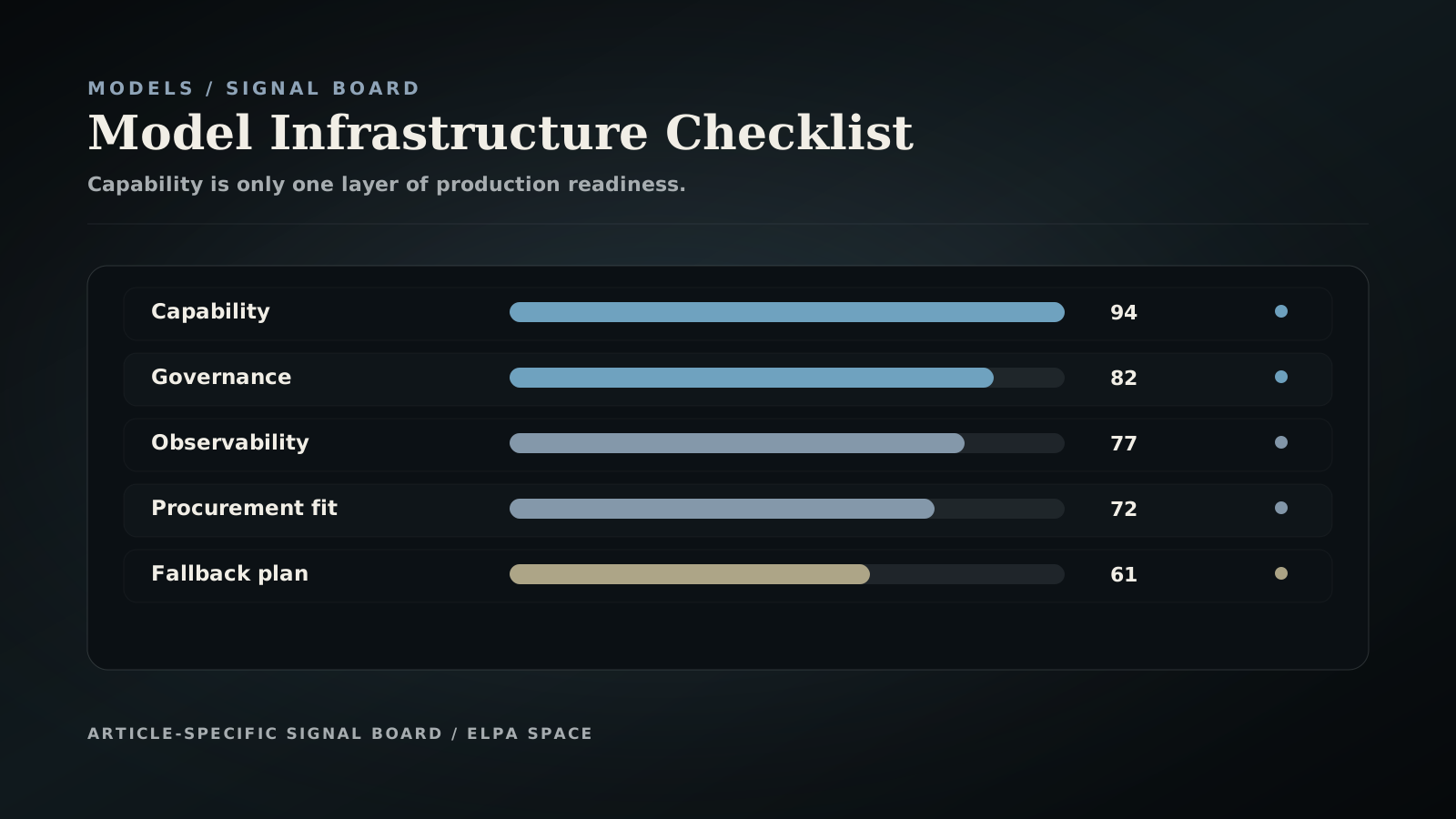
Infrastructure Questions Beat Demo Questions
Enterprise machine learning and AI platform procurement teams must carefully distinguish raw neural network benchmark performance from MLOps maturity and operational deployability. A large language model achieving state-of-the-art scores on natural language inference, code synthesis, multimodal AI, and instruction-following benchmarks may fail enterprise machine learning deployment requirements if it cannot satisfy data residency constraints, adversarial robustness thresholds, prompt injection vulnerabilities, or regulatory AI governance compliance policies. Conversely, a foundation model with lower benchmark accuracy may win production machine learning deployments by integrating with MLOps infrastructure, supporting supervised fine-tuning (SFT), low-rank adaptation (LoRA) or quantized low-rank adaptation (QLoRA) parameter-efficient fine-tuning, and direct preference optimization (DPO), and delivering lower latency through FP8 quantization, speculative decoding, KV cache optimization, and knowledge distillation from massive teacher networks.
| Reader question | What matters now | Editorial answer |
|---|---|---|
| What changed? | Models moved into platforms | Evaluate them as operating layers. |
| Who wins? | The best deployment fit | Model quality plus control beats demo quality. |
| What breaks? | Untracked model changes | Governance must follow the model. |
The New Buying Checklist
The machine learning systems infrastructure checklist now encompasses high-availability REST API uptime SLAs, multi-region distributed neural network inference deployment on accelerator hardware, semantic dataset drift detection using cosine similarity metrics, adversarial prompt injection and safety jailbreak monitoring, function-calling API trace observability, model version pinning policies, automated regression evaluation to detect model output probability distribution drift and capability degradation, and intelligent fallback routing to alternative deep learning models during provider outage events.
If a model failure would interrupt a workflow, it is no longer a feature. It is infrastructure.
From a computer science and systems architecture perspective, the future of frontier model competition will be decided by machine learning platform engineering and model gateway infrastructure that abstracts transformer architectures, multi-head attention layers, feed-forward networks, and neural network layer normalization complexity from application developers without eliminating machine learning governance and AI safety accountability. Winning AI infrastructure and generative AI platform products will surface model selection, intelligent routing, and versioning decisions with enough transparency for AI regulatory compliance and enterprise auditing, while keeping deep learning inference implementation details hidden from product engineering teams so they can build powerful generative AI and machine learning applications without requiring specialization in neural network architectures, backpropagation gradients, loss function regularization, or distributed computer systems design.
Entities In This Article
The article connects 3 named entities across 1 semantic clusters.
- OpenAI
AI research and product company behind ChatGPT and Codex.
- Amazon Bedrock
AWS managed service for foundation models and generative AI applications.
- Google Gemini
Google AI assistant and model product family.
Editorial Transparency
This article is produced inside ELPA SPACE's controlled AI-assisted editorial workflow. The named human editor remains responsible for publication quality, sourcing, updates, and corrections.
The byline identifies the author and the editor. Author profiles explain background, editorial responsibilities, and disclosure notes.
AI tools may help with research organization, draft iteration, metadata, and quality checks, but factual claims must be checked against reliable sources.
The page is created to explain an AI infrastructure shift for readers who follow models, agents, compute, search, and media distribution.
Readers can challenge a claim through the corrections channel. Material corrections are reflected in the update date when needed.